Dry Ice Detailing: Safe Engine-Bay Cleaning Explained
- August 19, 2026
- Auto Info
- Posted by Charles Oehmke
- Comments Off on Dry Ice Detailing: Safe Engine-Bay Cleaning Explained
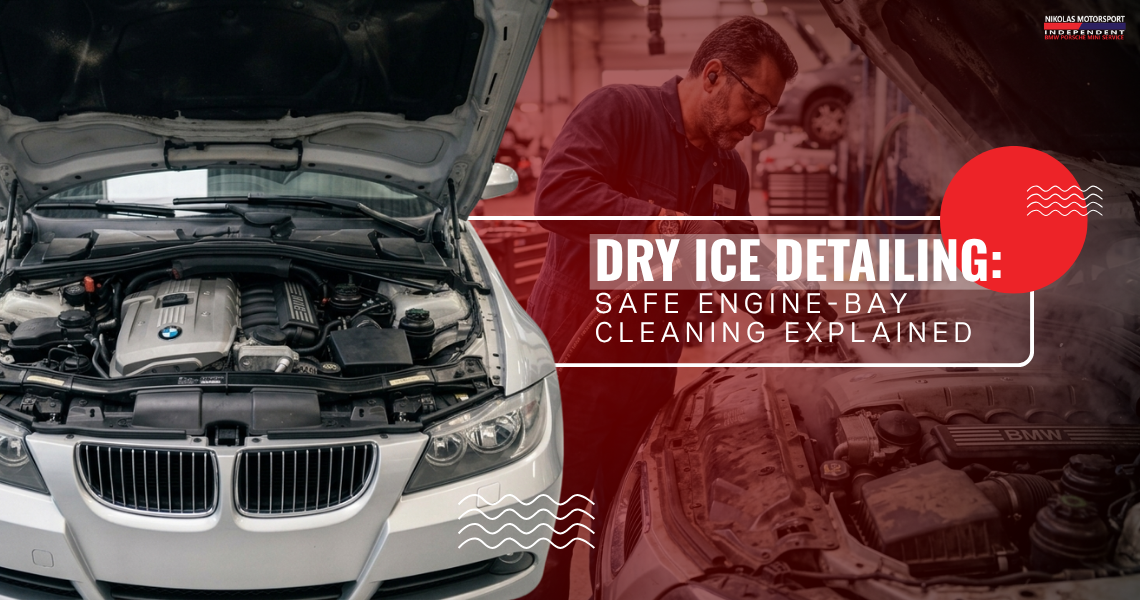
Woodward Avenue fills with clean cars every August, and the ones that draw a crowd have engine bays as sharp as their paint. A hose and degreaser is how people ruin coil packs. None of that goes into this process.
Dry ice blasting does the same job with no liquid at all, and the EPA reports the average American family uses more than 300 gallons of water per day at home.
Quick Summary: Key Takeaways
- Dry ice is solid CO2 at minus 109 degrees: Pellets freeze grime, then turn to gas.
- No water and no abrasive media: Nothing pools in connectors. Nothing sandblasts your finishes.
- It makes oil leaks findable: A clean bay separates a fresh weep from old residue.
- Great before a BMW or Porsche service: We blast bays ahead of valve cover work.
- Not a driveway project: Dry ice burns skin and CO2 displaces oxygen in closed garages.
Dry ice blasting cleans by thermal shock, not by scrubbing
The process fires compressed-air-driven pellets of solid carbon dioxide at the surface, and each pellet sits at roughly minus 109 degrees Fahrenheit. Impact does two things.
Extreme cold shocks the grease brittle and shrinks it away from the metal underneath, then the pellet flashes from solid to gas and expands several hundred times in volume. That expansion lifts the loosened debris clear.
Nothing is left behind. No slurry, no sand, no water in the harness connectors, no chemical film sitting on your intake manifold, and the pellets themselves simply disappear.
Water and degreaser are what actually damage an engine bay
Pressure washing an engine bay is a gamble, and owners lose it often enough that we see the aftermath, because water finds coil boots, plug wells and multi-pin connectors. Symptoms arrive days later.
A rough idle from a wet coil pack, an intermittent sensor fault, a corroded ground point nobody can trace, and sometimes a control module that fills with water and dies months on. Degreaser brings its own problems.
Strong solvents dull plastic covers and lift factory labels. They also leave a sticky residue that collects dust faster than the grime you removed in the first place. Dry ice leaves original finishes alone. Labels stay put.
A clean engine bay is a diagnostic tool for BMW, MINI and Porsche work
Cleaning the bay makes oil leaks solvable, which is the part owners never expect, because on a BMW N54 or N55 three different gaskets weep into the same area. Guessing is normal.
Once ten years of accumulated film is gone, we send the car home, get it back in a week and see exactly which gasket produced fresh oil. Same logic on a MINI R56 timing cover.
Porsche 911 undertrays benefit just as much. Add UV dye to clean surfaces and the source stands out immediately, which shortens diagnostic labor. You stop paying for gaskets that never leaked.
Michigan road salt makes the undercarriage worth blasting too
Salt is the enemy here, and Oakland County roads get treated heavily from November through March, so residue packs into suspension pockets, subframe seams and wheel wells. A car wash never reaches those.
Dry ice strips crusted salt and road film off control arms, subframes, exhaust hangers and the floor pan without soaking bushings or forcing water into cavities. On a garage-kept BMW or Porsche that is real corrosion prevention.
We usually pair it with an inspection, because once everything is clean, worn bushings and seeping seals are easy to spot from underneath. Every two years is plenty.
Our Pontiac shop runs dry ice detailing as a controlled process
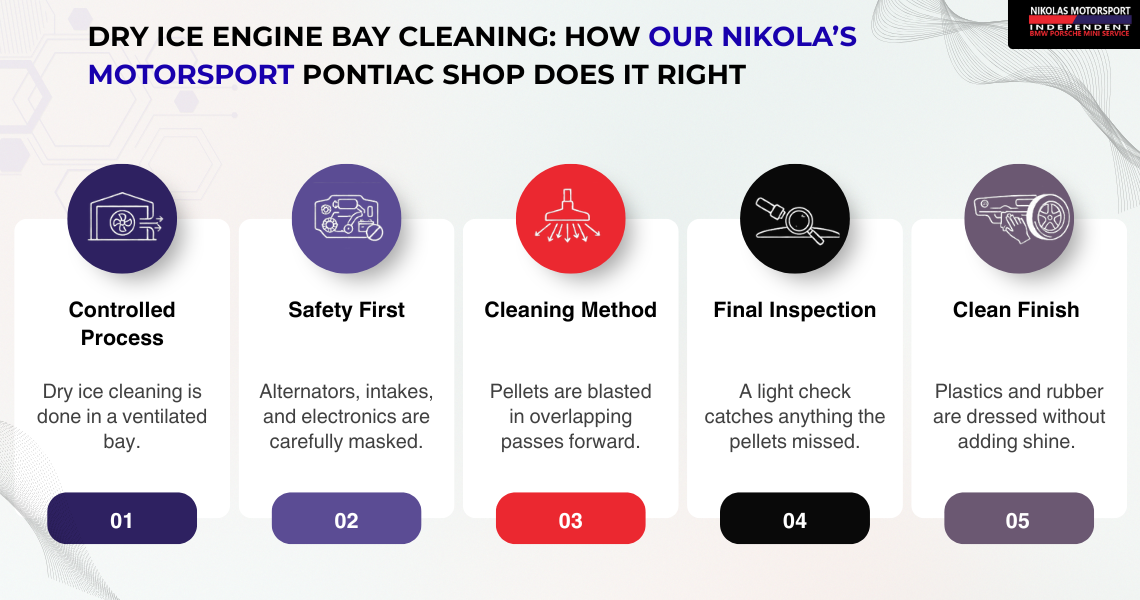
This work happens in a ventilated bay for good reason, because carbon dioxide displaces oxygen as it sublimates. The pellets cause frostbite.
Our process masks the alternator, intake openings and exposed electronics, then blasts in overlapping passes from the firewall forward before a light inspection catches anything the pellets missed. We finish by dressing plastics and rubber. Nothing shiny.
The bay should look correct, not glossy and wet. Most engine bays take two to four hours, depending on how much buildup has collected. We have worked only on BMW, MINI and Porsche on Woodward since 1987.
Frequently Asked Questions
Q: Is dry ice cleaning safe for a car engine bay?
A: Yes. With a trained operator working in a ventilated space there is no water and no abrasive media, so nothing pools in electrical connectors or sandblasts aluminum and plastic. We still mask the alternator, intake openings and exposed electronics.
Q: How long does dry ice engine bay detailing take?
A: Half a day at most. Plan on two to four hours for most BMW, MINI and Porsche bays. Heavily built-up bays on higher-mileage cars take longer, and adding the undercarriage or wheel wells extends it, and we give you a time estimate after looking the car over.
Q: Does dry ice blasting remove paint or damage decals?
A: No. It does not remove factory paint, and it leaves hose markings and warning labels intact. That is exactly why concours owners prefer it. The pellets are not abrasive, so they lift contamination without cutting the surface beneath.
Q: Can I do dry ice cleaning myself at home?
A: We do not recommend it. Dry ice sits at minus 109 degrees and causes frostbite on contact, and the gas it releases displaces oxygen in an enclosed garage. The equipment also needs more compressed air volume than home compressors supply.
Book dry ice detailing before your next Woodward weekend
Book early. Show prep or an oil-leak hunt, a clean bay makes both easier. Book an appointment at our Pontiac shop and tell us if you want the undercarriage included.
Nikolas Motorsport – 45108 Woodward Ave, Pontiac, MI 48341
Hours: Mon-Fri 8:00 AM to 5:30 PM; closed Saturday and Sunday
Website: nikolasmotorsport.com