Your BMW’s Check Engine Light Only Comes On Cold Mornings? Look at the Oxygen Sensor Heaters
- September 21, 2026
- BMW Repair
- Posted by Charles Oehmke
- Comments Off on Your BMW’s Check Engine Light Only Comes On Cold Mornings? Look at the Oxygen Sensor Heaters
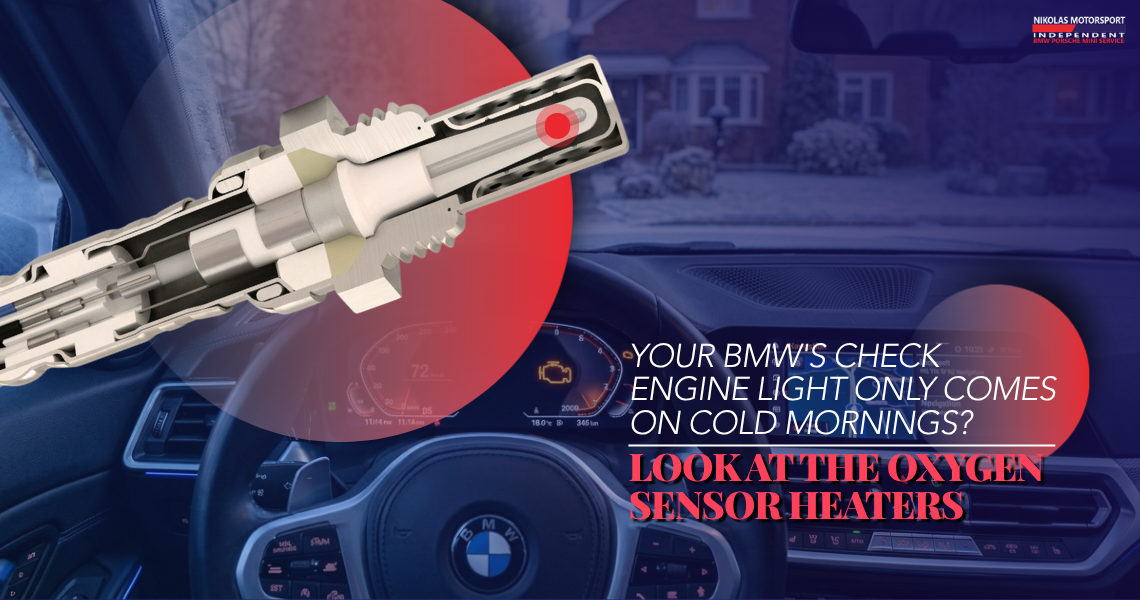
The light appears on the way to work and is gone by the afternoon. Next cold morning, back again. Warm days, nothing at all — which makes it easy to talk yourself into ignoring it.
A fault that tracks the temperature is telling you something specific. On a BMW, MINI or Porsche, an oxygen sensor heater circuit that has gone high-resistance will pass on a mild afternoon and fail at 35 degrees, and Pontiac gets a lot of 35-degree mornings between now and Thanksgiving.
Quick Summary: Key Takeaways
- Cold-start-only codes are real: A heater circuit fault sets when the sensor warms too slowly, which happens first in cold weather.
- The heater is not the sensing element: It is a separate circuit, so it can fail while the sensor still reads exhaust correctly.
- It costs you fuel: Until the sensor is hot the engine runs a fixed rich mixture, and cold-weather city mileage is already down about 15 percent.
- Wiring fails more than people think: Chafed wires and corroded connectors set the same code as a dead sensor.
- Ignoring it loads the converter: Rich running sends unburned fuel into a part that costs several times the sensor.
What the Heater Inside an Oxygen Sensor Is Actually For
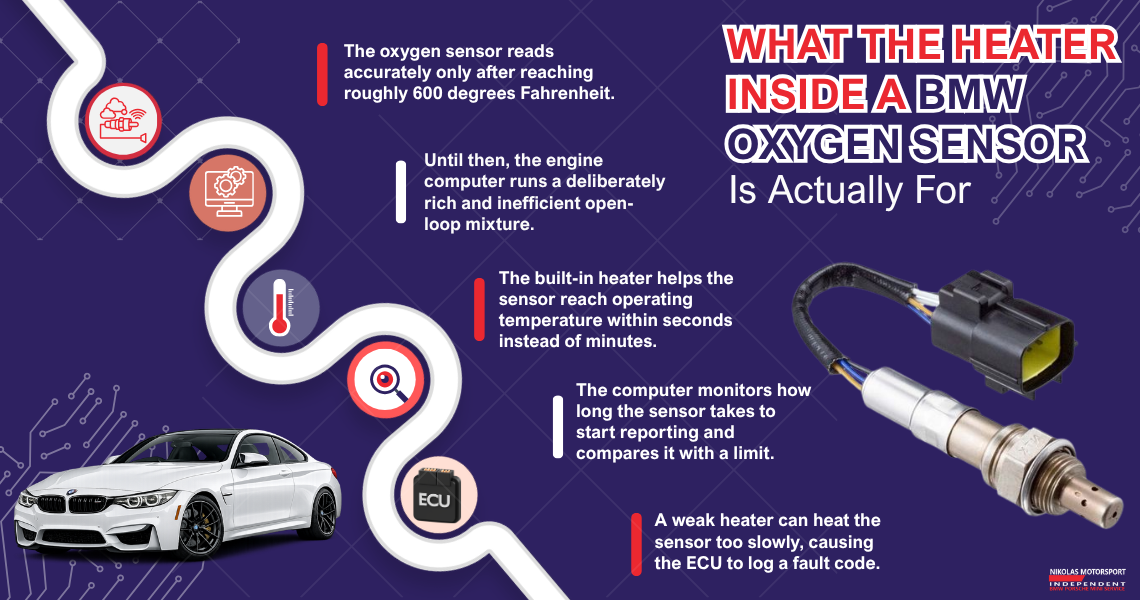
An oxygen sensor only reads accurately above roughly 600 degrees Fahrenheit. Until it gets there the engine computer cannot trust it, so it runs a preprogrammed open-loop mixture that is deliberately rich and deliberately inefficient.
The built-in heater shortens that window from minutes to seconds. On a modern BMW or Porsche the computer times how long each sensor takes to start reporting and compares it against a limit. That is where the fault comes from.
So the code is a stopwatch complaint. The sensor got hot too slowly, and on a cold morning a weak heater misses the deadline by enough for the ECU to log it.
Why the Light Comes and Goes With the Weather
Resistance climbs as the element ages. At 60 degrees it still reaches temperature inside the allowed window; at 30 degrees, with heat bleeding into cold pipe and cold air, it does not. Same part. Different verdict.
That is the whole mechanism. Same part, same fault, different starting temperature — which is why a Porsche that logged one code this week will be logging it every morning by November.
Owners often clear it and move on. That works for exactly as long as the weather cooperates.
Wiring and Connectors Cause as Many of These Codes as Sensors Do
The sensor is the expensive suspect, not always the guilty one. Oxygen sensor harnesses run within inches of hot exhaust, get pushed around by heat shields, and eventually chafe through the insulation against a bracket.
Then Michigan does its part. Salt and slush wick into the connector, the pins corrode, and resistance rises in a circuit already carrying a heater load. Same code. Different repair entirely.
On a MINI the front sensor connector sits where every winter puddle reaches it, so we always inspect and measure at the connector before quoting a sensor.
What Ignoring It Actually Costs Over a Winter
Fuel first. Running rich longer on every cold start adds up quickly on short trips, and federal testing already shows city fuel economy roughly 15 percent lower at 20 degrees than at 77 degrees before you add a fault into the mix.
Then the converter. Unburned fuel reaching a catalytic converter raises its temperature and shortens its life, and replacing one on a BMW costs several times what the sensor and an hour of labor would have.
And a lit dash blinds you. With the light already on you cannot see the next fault the car tries to report, which is a poor trade for a repair this small.
How We Separate a Bad Sensor From a Bad Circuit
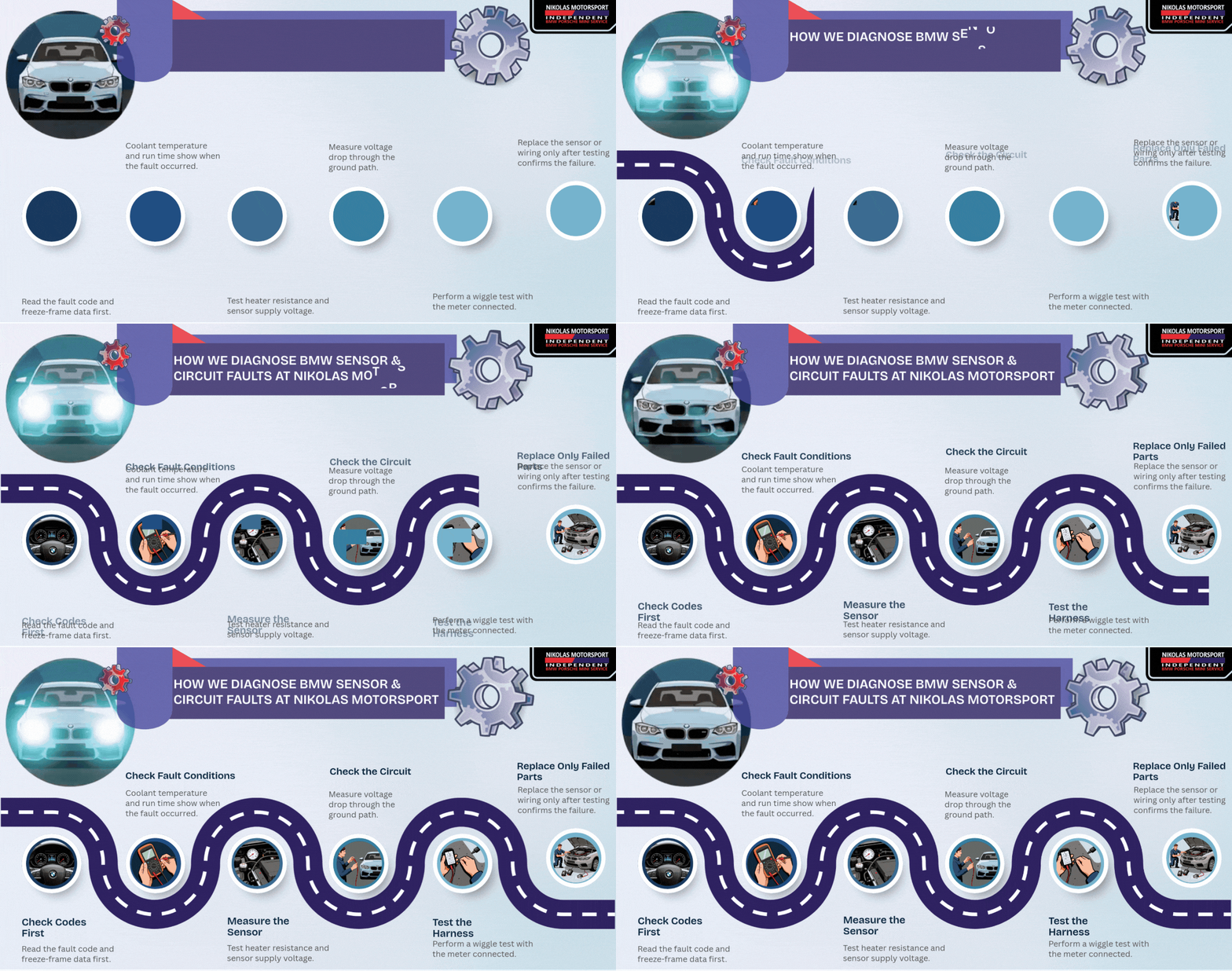
It starts with the code and the freeze-frame data, because knowing the coolant temperature and run time when the fault set tells us whether this is a genuine cold-start problem or something else wearing the same code.
Then we measure. Heater resistance at the sensor, supply voltage from the relay, voltage drop through the ground path, and a wiggle test on the harness with the meter connected — that sequence separates a dead element from a broken wire in about twenty minutes.
We only replace what fails a test. Guessing is what turns a one-part repair into three.
Pontiac Owners Are Heading Into the Season That Exposes This
Cold mornings are the test bench. If the light flickered once on a chilly start, it will be steady before the first snow, and diagnosis is easier while the fault still sets on schedule.
We are on Woodward Avenue in Pontiac and we work on exactly three marques — BMW, MINI and Porsche. That is the whole list, and it is why the scan tools, the wiring diagrams and the parts knowledge here go deeper than a general shop’s.
Drivers come to us from Bloomfield Hills, Royal Oak, Troy and Rochester Hills. Bring the car in with the code stored if you can.
Frequently Asked Questions
Q: What does an oxygen sensor heater circuit code mean?
A: The sensor warmed up too slowly. The computer times how quickly each oxygen sensor starts reporting after a cold start, and when the heater element or its wiring goes high-resistance the sensor misses that window.
Q: Why does my check engine light only come on when it’s cold?
A: Because cold weather is what pushes a marginal circuit past its limit. A heater element with rising resistance still warms the sensor fast enough on a mild day, but not at 30 degrees. The same fault becomes a daily event as temperatures drop.
Q: Can I keep driving with an oxygen sensor heater fault?
A: Short term, yes. The car will feel normal while you burn extra fuel on every cold start and gradually load the catalytic converter with the leftovers. Fix it before winter, not after.
Q: Is it the oxygen sensor or the wiring?
A: You cannot tell from the code, which is the whole point of testing. Measuring heater resistance at the sensor and voltage drop through the supply and ground separates a failed element from a chafed wire or a corroded connector.
Get the Cold-Start Code Diagnosed While It Still Sets
An intermittent fault is easiest to find while it is still intermittent in a predictable way. Book a visit, tell us which mornings it appears, and we will measure the circuit rather than guess at the sensor.
Nikolas Motorsport — 45108 Woodward Ave, Pontiac, MI 48341
Hours: Mon-Fri 8:00 AM-5:30 PM; Sat-Sun closed
Website: nikolasmotorsport.com